Food Truck Design For Cold Weather
It's 6:47 AM in Minneapolis, and the thermometer on your phone reads -14°F. Your truck's been parked outside all night. The water lines are frozen solid, the propane heater won't kick on, and you have a catering gig at 11 that you can't cancel. This isn't a hypothetical. It's a Tuesday.
Most food truck design for cold weather advice you'll find online was written by someone in California who thinks a "cold snap" means wearing a light jacket. The truth is harsher: without proper insulation and heating, your truck becomes an expensive metal coffin for your business. And the fix isn't as simple as buying a space heater.
Why Your Truck Loses Heat Faster Than You Think
Here's what nobody tells you about food truck construction: most build-outs use materials that are terrible at retaining heat. Aluminum walls conduct cold like they're designed for it. Single-pane windows bleed warmth. And the floor? Most trucks have none—just bare metal over the chassis.
The math is brutal. A standard 16-foot food truck has roughly 400 square feet of surface area. Without insulation, that's 400 square feet of heat loss in every direction. Your heating system isn't just fighting the outside temperature—it's fighting your own walls.
The fix starts before the build-out, not after. Closed-cell spray foam insulation runs about $1.50 to $3 per square foot at 1-inch thickness. A full truck runs you between $600 and $1,200. That's the single best investment you'll make for winter operations, and most owners skip it because they're already over budget.
The Heating System Nobody Mentions
Everyone talks about propane heaters. Few talk about the difference between forced-air and radiant systems—and that difference is the line between a functional kitchen and a frozen one.
Forced-air propane heaters are cheaper upfront, around $400 to $800 installed. They work fine until the wind picks up. The problem is they heat the air, not the surfaces. In a drafty truck, that warm air escapes faster than you can generate it.
Radiant tube heaters mounted under the counter heat the metal, the equipment, and your body directly. They cost more—expect $1,200 to $2,500 installed—but they keep working when a gust of wind slams your side door. For a winter-focused operation, that's the difference between serving and shutting down.
One more thing: your water system. Tank heaters run $150 to $400 per tank, and you need them on both fresh and gray water tanks. Skip this, and you'll learn what "frozen pump" means at the worst possible moment. I've seen it happen to a vendor in Chicago who lost an entire weekend of revenue because he saved $300 on tank heaters.
Ventilation: The Counterintuitive Winter Problem
Here's where it gets interesting. In summer, you want maximum ventilation. In winter, you need to balance heat retention with the fact that you're cooking with fire and gas inside a sealed box.
Carbon monoxide doesn't care about your comfort. The NFPA 96 standards require specific ventilation that doesn't disappear just because it's cold outside. The mistake I see constantly is owners sealing vents to keep heat in. That's how you end up with a headache, nausea, and a visit from the fire marshal.
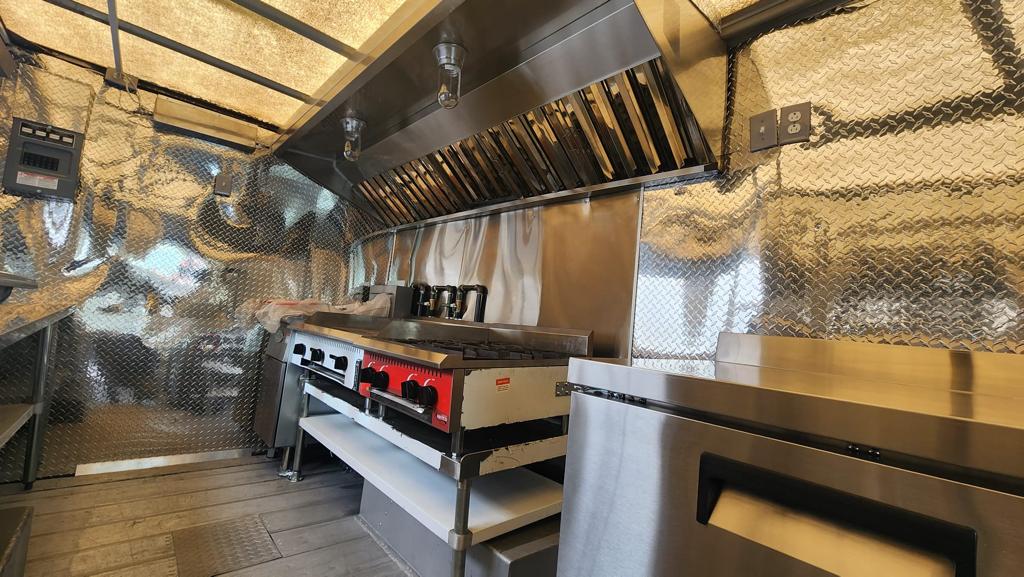
The solution is a two-speed exhaust system. Run it at low speed in winter to retain heat while still moving air. Installation runs $1,500 to $3,500 depending on your setup, but it's non-negotiable if you're cooking with propane or gas.
Flooring and Door Seals: The Overlooked Culprits
Most heat loss happens at the edges. Door seals compress and crack within a year. The gap under your rear door—the one you never notice in July—becomes a 2-inch wind tunnel in February.
Replace all weatherstripping before winter hits. That's $50 to $150 in materials and an afternoon of work. For the floor, rubber diamond plate with a foam underlayment costs $3 to $6 per square foot and makes a massive difference. Your feet will thank you, and so will your heating bill.
The real question is whether you're building for year-round operations from the start. If you're converting a used van or trailer, the food truck vs concession trailer decision matters more than you think. Concession trailers have more wall space for insulation. Food trucks have better mobility. Your climate should factor into that choice.
What the Numbers Actually Look Like
Let me give you a concrete example. A client in Denver converted a 20-foot trailer for year-round operations. The insulation package ran $2,800. Tank heaters cost $600. Radiant heating was $1,900. Ventilation upgrades came to $2,200. Total: $7,500 for a truck that works in negative temperatures.
That sounds like a lot until you compare it to the alternative. A truck that can't operate in winter loses roughly 30% of its annual revenue potential in northern markets. If you're grossing $8,000 a month, that's $2,400 a month of lost revenue—meaning the winterization pays for itself in just over three months of recovered sales.
For a deeper look at the full build costs, check out this food truck build cost breakdown for Washington State in 2026. The principles apply anywhere, but the numbers are specific.
The Permit Problem Nobody Warns You About
Here's the thing that catches most operators off guard: your winter modifications might require a new inspection. Adding propane lines, changing ventilation, or modifying the electrical system triggers a re-inspection in most jurisdictions. That's not a suggestion—it's a requirement.
If you're in Virginia, the Virginia food truck conversion specialists can walk you through local requirements. And if you're in Washington State, the mobile food unit permit costs updated for 2026 will give you a realistic picture of what you're facing.
The point isn't to scare you. It's to prevent the "I didn't know" moment that costs you $500 in fines and a canceled event.
Building Smart vs. Building Expensive
The smartest approach is planning for cold weather from day one. Retrofitting is always more expensive than building it right the first time. If you're already in the design phase, talk to someone who's actually done this before you sign off on your build.
For the basics of running a successful operation, the food truck success tips cover more ground than just winterization. But the cold-weather piece is the one most new operators get wrong.
Here's what I'd tell a friend: spend the extra money on insulation and heating now. Skip the fancy wrap. Skip the custom countertops. Winterize first, decorate second. A truck that runs in January is worth more than a pretty truck that sits idle until March.
The Real Cost of Being Cheap
I've watched operators try to save $2,000 on insulation and lose $15,000 in canceled events during their first winter. The math isn't complicated. The decision is just uncomfortable because it means spending money before you're making money.
If you're serious about operating through winter, get a custom quote from people who've built cold-weather trucks before. It's not about the sales pitch—it's about the specifications they'll give you for your specific climate and concept. Every region has different requirements, and the person who's done this 50 times knows things you'll learn the hard way.
The difference between a truck that dies in December and one that thrives in February isn't luck. It's design decisions made months earlier. You're making those decisions now, whether you realize it or not.
For more information, visit get a custom quote.
Te puede interesar: Food Truck Generator Sizing Calculator: Right Power for Your Build
Te puede interesar: Food Truck Branding Ideas for Washington State: Stand Out Locally
Te puede interesar: Houston food truck fire suppression system requirements: what you need to know