Food Truck Generator Sizing Calculator: Right Power for Your Build
How Much Power Does Your Food Truck Actually Need?
You're standing in a metal box on wheels, staring at a list of equipment that will make or break your business. A commercial fryer. A griddle. A refrigerator. A POS system. And you're asking yourself: what size generator do I actually need?
This is where most food truck owners get it wrong. They either guess. They ask their buddy who owns a taco truck. Or worse—they buy whatever the food truck builder recommends without questioning it.
The truth: a food truck generator sizing calculator is the difference between equipment that runs smoothly and equipment that fails during your lunch rush. And there's real money at stake.
A 30kW generator costs around $8,000–$12,000. A 50kW generator runs $15,000–$20,000. Buy the wrong size and you're either replacing it in six months or you've overspent on capacity you'll never use. Neither option is acceptable when your margins are already tight.
Why Your Current Generator Estimate Is Probably Wrong
Here's what nobody tells you: equipment manufacturers list peak wattage, not running wattage. A commercial fryer might have a peak draw of 5,500 watts when it first fires up. But its continuous draw is 3,200 watts. If you add up every peak number on your equipment list, you'll oversize your generator by 40–50%.
And that's just the starting point.
When multiple pieces of equipment run simultaneously—your fryer, griddle, and refrigerator all pulling power at the same time—you don't add their peak wattages together. You need to account for diversity factor. This is where a food truck generator sizing calculator actually earns its place in your planning process. It doesn't just add numbers. It accounts for what realistically runs at the same time.
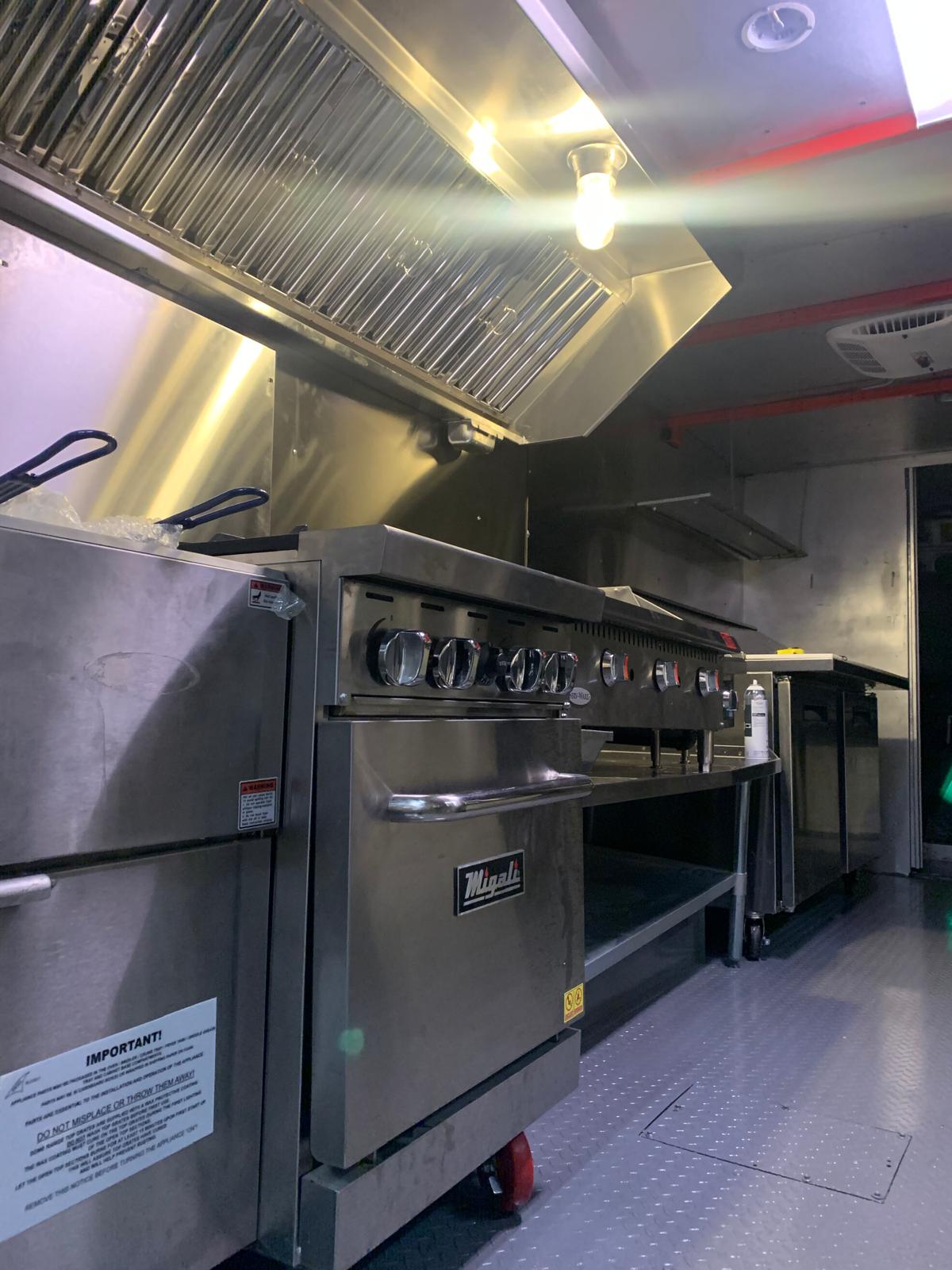
Take a typical Houston food truck with a full kitchen setup. Fryer (3,200W continuous), flat-top griddle (4,500W), walk-in cooler (2,800W), hood suppression system (1,200W), POS and lighting (800W). That's 12,500 watts of equipment. But they're not all running at maximum simultaneously during service. A proper calculation drops that to a realistic 18–20kW continuous demand, not the 25–30kW that most builders recommend.
The difference? About $6,000 in generator cost you didn't need to spend.
What a Food Truck Generator Sizing Calculator Actually Does
A real food truck generator sizing calculator works like this:
Step 1: List every piece of equipment. Not just the big stuff. Include your POS system, credit card reader, lights, exhaust fans, water pumps, and ice makers. Every single thing that draws power.
Step 2: Find the running wattage for each. Not the peak. The continuous draw. This is in the equipment specifications, usually in the fine print. Manufacturers know the difference. Most food truck owners don't.
Step 3: Calculate simultaneous load. Which equipment runs at the same time during peak service? Your fryer and griddle? Yes. Your fryer and ice maker? Probably not. A calculator accounts for this.
Step 4: Add headroom. You need 10–15% extra capacity for voltage drop, efficiency losses, and the fact that your equipment won't run perfectly forever. A 20kW demand becomes a 23–24kW generator specification.
That's the process. It's not complicated. But it requires actual data, not guessing.
Real Numbers: What Different Food Truck Setups Actually Need
Let's be concrete. Here are three real-world scenarios based on actual food truck builds in Texas:
Scenario 1: Taco/Burrito Truck
Equipment: One fryer, one flat-top griddle, one refrigerator, hood system, POS, lighting. Calculated continuous load: 18kW. Recommended generator: 22kW. Cost: $10,500–$13,000.
Scenario 2: Barbecue Truck
Equipment: One smoker (1,800W continuous—yes, lower than you'd think), one warmer, two refrigerators, hood system, POS, water system. Calculated continuous load: 12kW. Recommended generator: 16kW. Cost: $7,500–$9,500.
Scenario 3: Full-Service Kitchen Truck
Equipment: Two fryers, griddle, convection oven, three-door refrigerator, ice maker, hood suppression, POS, water heater. Calculated continuous load: 28kW. Recommended generator: 35kW. Cost: $18,000–$24,000.
Notice the pattern? Most builders add 20–30% extra capacity "just in case." That's expensive insurance for a problem that won't happen if you calculate correctly.
Where Most Food Truck Owners Go Wrong
The biggest mistake isn't undersizing. It's oversizing without knowing it.
A generator running at 30% capacity is inefficient. It burns more fuel per watt produced. It has shorter maintenance intervals. And it takes up valuable space in your truck. If your calculated need is 20kW and you install a 35kW generator because a builder recommended it, you're paying for capacity you'll never fully use while your operating costs stay unnecessarily high.
The second mistake is forgetting about future expansion. If you're planning to add a second fryer or a convection oven in year two, you need to account for that now. A food truck generator sizing calculator should include a line item for planned equipment additions. This is where professional consultation matters more than a generic online tool.
The third mistake—and this one costs real money—is not accounting for your local electrical infrastructure. In some areas, you'll be plugging into shore power at events. In others, you're running completely off-grid. Your generator needs change based on where you actually operate. A calculator that doesn't ask about your location is missing critical information.
Getting the Calculation Right for Your Specific Build
You have two options. Use a generic food truck generator sizing calculator online—and hope it accounts for your specific equipment mix. Or work with someone who understands food truck electrical systems and can give you a number you can actually trust.
If you go the DIY route, start with the equipment specification sheets. Call the manufacturer if the wattage isn't clear. Don't estimate. Don't round down. Get the actual running wattage for every piece of equipment you're installing.
Then add 15% for headroom and losses. That's your target generator size.
If you want a number you can build a budget around—one that factors in your specific equipment, your location, and your growth plans—that's worth a conversation with someone who builds food trucks regularly. They've seen what works. They know where the calculations usually go wrong. And they can help you avoid the $6,000–$8,000 mistakes that happen when you oversizing without thinking.
Whether you're building from scratch or converting a van, the generator is one decision where being precise actually saves money. It's not a guess. It's a calculation. And the right one changes everything about how your truck runs.
If you want to see real numbers for your specific concept and equipment list, get a custom quote that includes a proper power analysis. Or explore our guide on custom food truck cost breakdown for 2026 to understand how generator sizing fits into your total build budget. For Houston-specific builds, our custom food truck builders guide includes vendors who handle electrical planning correctly from day one.