Food Truck Wrap Design: How to Brand Your Mobile Kitchen
Most Food Truck Wrap Design Advice Is Written by People Who've Never Stood at a Window at Midnight
Here's the number that should bother you: a wrap job typically runs $3,000 to $6,000 for a full commercial vehicle, and roughly 40% of new food trucks fail within the first two years. Those two facts are connected more than anyone admits. Your food truck wrap design is the single most-seen marketing asset you own — it works 14 hours a day in traffic, at festivals, outside office parks. And yet most operators treat it like a logo they picked off a template.
I've watched trucks with $60,000 kitchens lose to trucks with $12,000 kitchens because one of them could be read from across a parking lot. The food was identical. The line wasn't.
So let's talk about what actually matters, because the gap between a wrap that prints and a wrap that sells is enormous.
What Nobody Tells You About Food Truck Wrap Design: It's a Billboard, Not a Business Card
Everyone already knows the basics: put your logo on it, use bright colors, add your Instagram handle. Great. None of that is the problem.
The problem is that you're designing for a customer standing three feet away, and your customer is actually sitting in a car doing 25 mph, or walking a festival crowd scanning twelve trucks at once. You have about four seconds. Maybe less.
That changes everything. Here's the test I use: shrink your design to thumbnail size on your phone and look at it from arm's length. If you can't read your food type and your name, you've failed. Most trucks fail this test.
A few things that separate a wrap that works from a wrap that just looks nice:
Readable at distance beats clever at close range
Script fonts look elegant in the mockup and turn to mush at 40 feet. The best-performing trucks use one bold sans-serif for the name and one clear secondary font for the menu hint. That's it. The truck that says "TACOS" in six-inch block letters outsells the one that says "Casa de la Tradición" in a swooping cursive nobody can parse from the sidewalk.Your food has to be on the truck
This sounds obvious and almost nobody does it. A photo of the actual product — the taco, the burger, the brisket — does more selling than any logo ever will. People buy food with their eyes before they read a single word. If your wrap doesn't make someone hungry, it's decoration.Contact info is not the point
Nobody memorizes a phone number off a moving truck. Put your social handle and a QR code to your location schedule, then stop. The valuable real estate is your name, your food category, and something that makes a person pull over. The rest is filler.The Four-Second Rule: How to Test Your Food Truck Wrap Design Before You Spend a Dime
Here's where it gets interesting. You can validate a wrap concept for free, and you should, because reprinting is a $4,000 mistake you don't get to make twice.
Print your design at full scale on cheap paper (or tape a printout to a cardboard box). Put it across a parking lot. Have five people who don't know your concept look at it for four seconds, then look away. Ask them: what do I sell, and what's the name? If fewer than four get both right, back to the drawing board.
Let me give you a concrete example. A Houston operator I know spent $5,200 on a wrap with a gorgeous illustrated map of Texas and a hand-lettered name. Beautiful work. Nobody could read it. He re-wrapped for another $3,800 with a flat red background, a half-truck photo of a smoked brisket, and "HOUSTON BBQ" in white block letters. His lunch traffic at the same spot jumped noticeably within a month. Same food. Same location. Different four seconds.
The lesson isn't "make it ugly." It's that clarity and appetite win, and the design has to serve both.
What a Wrap Actually Costs, and Where the Money Goes
Since we're being honest about numbers: budget $3,000 to $6,000 for a full commercial wrap, depending on truck size and design complexity. Partial wraps run $1,500 to $3,000. A custom design fee from a designer who understands vehicle graphics is typically $500 to $1,500 on top of that.
Where people overspend: intricate illustrations, dozens of colors, and metallic or textured vinyls that look incredible at the shop and cost double to install. Where people underspend and regret it: the design itself. Paying a real designer who has wrapped vehicles before is not a luxury — it's the difference between a $4,000 asset and a $4,000 liability.
And this is worth saying plainly: your wrap budget is a line item in your build, not a separate thing. If you're still mapping out total costs, our breakdown of food truck build costs in 2026 puts the wrap in context against the kitchen, the permits, and the equipment. It's a small slice of the pie — but it's the slice every customer sees first.
Branding Your Mobile Kitchen Means Thinking About the Whole Truck, Not Just the Panel
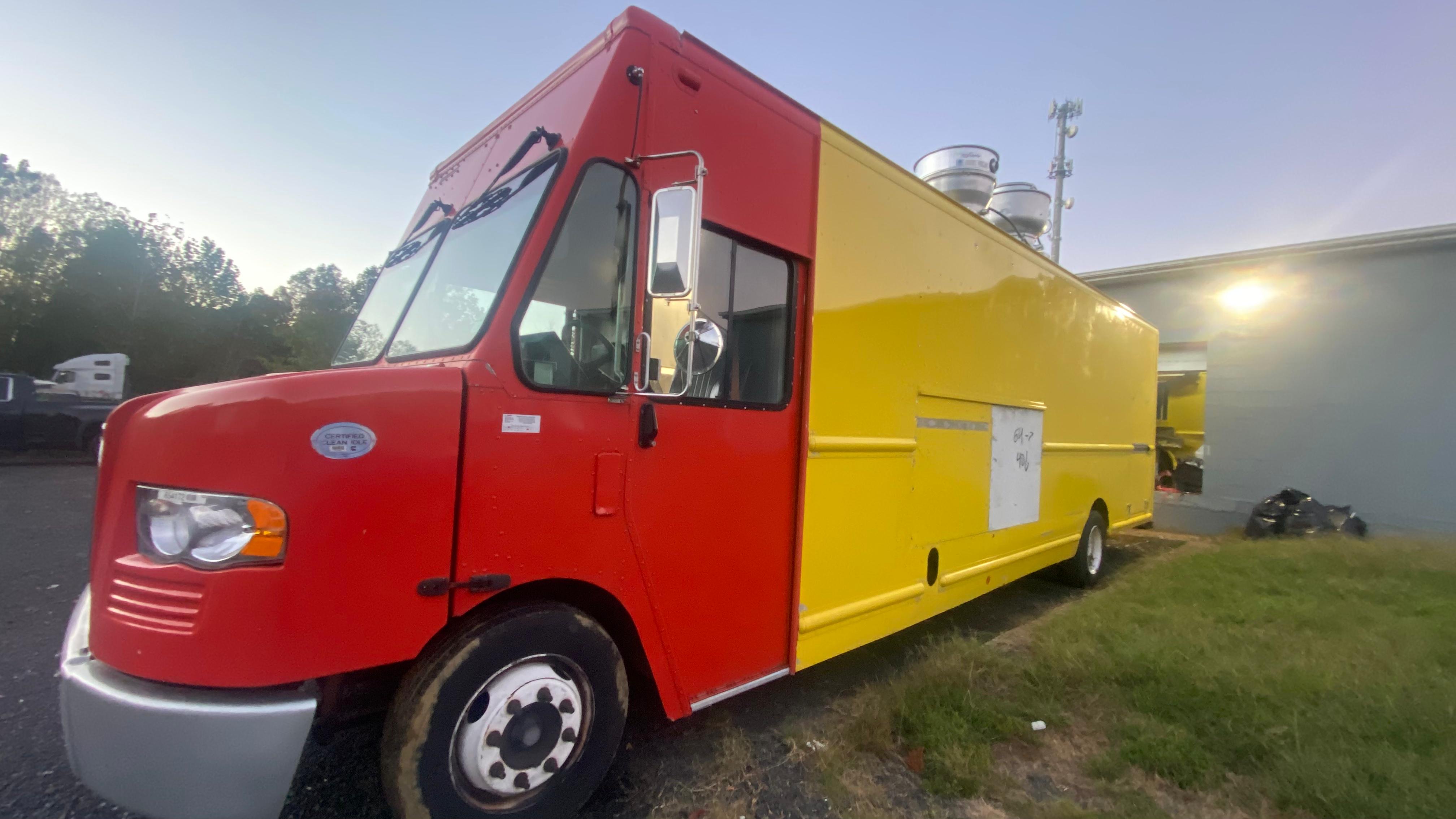
The wrap is the loudest part of your brand, but it's not the only part. What happens when the window slides open matters just as much, and a wrap that doesn't account for the service side looks disjointed up close.
A few practical points that separate a professional operation from an amateur one:
- Wrap the service window frame in your brand colors. It frames every transaction and every photo a customer takes.
- Coordinate with your menu board. If the board is a laminated sheet of paper taped to the truck, the wrap is wasted. The menu is where the customer actually commits.
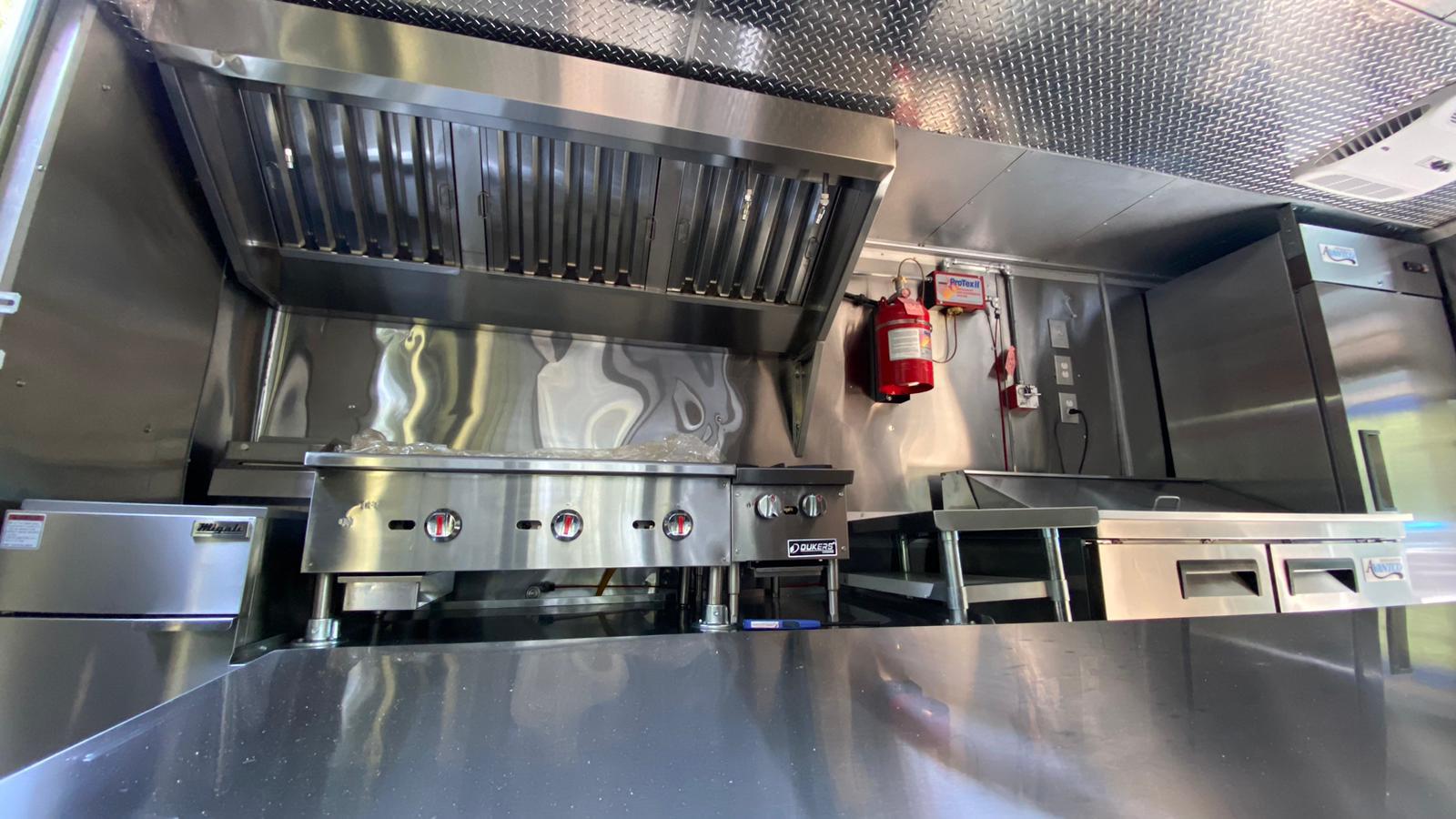
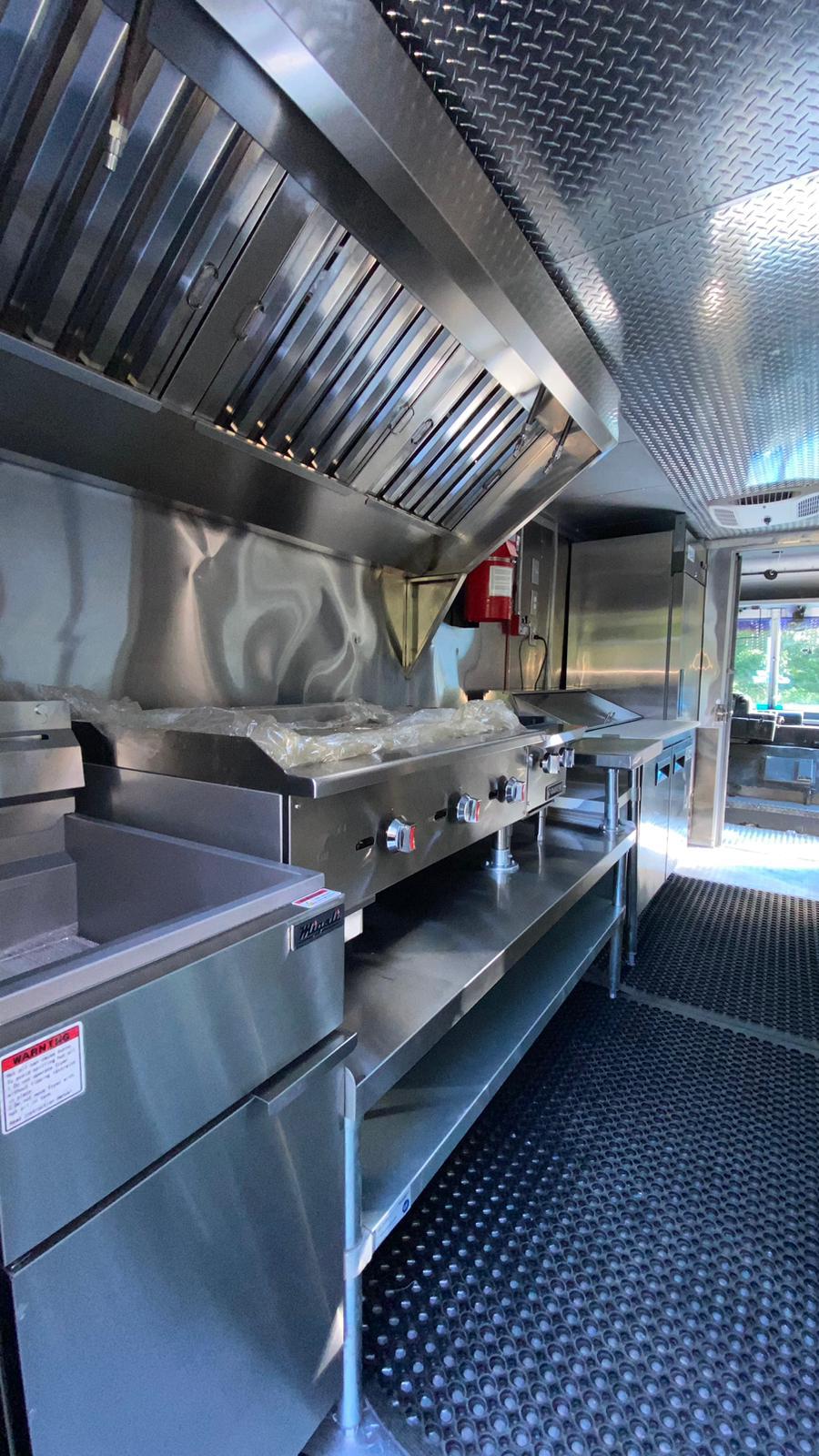
- Match the interior. When the window opens, people glimpse inside. A clean, organized kitchen reads as trustworthy. A chaotic one reads as risky, and food safety perception is real. Our guide to food truck kitchen layout for efficiency covers how the interior and service flow work together.
And here's where it gets interesting: the trucks that look the most professional on the outside are almost always the ones built with the service flow in mind from day one. Branding isn't a layer you add at the end. It's baked into the build.
The Legal and Practical Stuff Nobody Mentions in the Design Phase
Before you fall in love with a design, check your local rules. Some cities restrict how much of a vehicle can be covered in certain vinyls, and some health departments care about what's on the surface near the service window. It's not usually a dealbreaker, but you don't want to discover it after the wrap is printed.
This is especially true if you're operating in multiple markets. If you're building for Texas, Virginia, or Washington, our rundown of food truck permit requirements in Houston, VA, and WA covers the regulatory landscape — and if Virginia is in your plans, the Virginia food truck regulations for 2026 are worth reading before you commit to a design and a build. Getting the paperwork and the wrap in the same conversation saves you a very expensive reprint.
If you're earlier in the process and still working out the whole build, the step-by-step guide to building a food truck in 2026 puts the wrap where it belongs: after the kitchen, before the launch.
So What Should Your Wrap Actually Say?
Strip it down to the essentials and it gets simple. Your wrap needs four things, in this order of visual priority:
1. Your food category, huge. "TACOS," "BBQ," "COFFEE." A person scanning a crowd needs to know what you sell before they know who you are. 2. Your name, bold and readable. One font. No script. 3. A photo of the actual food. Something that makes a hungry person stop walking. 4. Where to find you. One social handle and a QR code to your schedule. Done.
Everything else — the clever tagline, the illustrated map, the twelve-color gradient — is optional, and usually a net negative. The best wrap is the one a distracted person understands in four seconds and remembers an hour later.
If you're planning a build and want the wrap, the kitchen, and the service flow designed as one system instead of three separate headaches, it's worth having a real conversation before you order vinyl. You can get a custom quote for a build that treats branding as part of the truck, not an afterthought. And if you're still deciding what your truck should even look like, mobile kitchen consultations can save you from a very expensive reprint.
The truth is, your wrap isn't marketing. It's your storefront, your menu, and your first impression, all moving at 25 miles an hour. Design it like the four seconds are the only four seconds you get — because they are.