How to Calculate Food Truck Profit Margin: Simple Guide
You're Probably Pricing Wrong — Here's the Math That Fixes It
How much money do you actually keep from every taco or burger you sell? If you can't answer that in under 30 seconds, you're driving a very expensive hobby, not a business.
Learning how to calculate food truck profit margin isn't accounting homework. It's the difference between growing a fleet and selling your rig at a loss by year two. The formula itself is simple: (Revenue – Total Costs) ÷ Revenue × 100. But the real question is whether you're counting the right costs.
Most owners track food and labor. That's it. Then they wonder why the bank account doesn't match the spreadsheet.
What Nobody Mentions: The Costs That Eat Your Margin
Here's where the math gets uncomfortable. Your true cost per dish includes:
- Food cost — typically 25-35% of your selling price
- Labor — 20-30%, and that's before you pay yourself
- Commissary kitchen fees — $300 to $800 per month in cities like Houston
- Fuel and generator maintenance — $200-500 monthly depending on how much you drive
- Insurance — commercial coverage runs $2,000-4,000 per year
- Permits and licenses — Houston food truck permits alone can cost $500-1,500 annually depending on your county
- Truck depreciation — this one hurts. A $60,000 truck loses value every single mile.
Add those up and a $12 burrito with $3.50 in ingredients might only net you $2.30 after everything. That's an 19% margin — decent if you sell 150 a day, brutal if you sell 40.
The fix isn't just raising prices. It's knowing which items on your menu actually carry your overhead.
How to Calculate Food Truck Profit Margin Per Item (Not Just Per Month)
Stop calculating your margin on monthly revenue alone. You need per-item math because some dishes are subsidizing others.
Here's the formula that works:
1. List every ingredient — yes, including the squeeze of lime and the pinch of salt 2. Add your packaging — that eco-friendly container costs 40 cents, not 10 3. Divide your fixed costs by projected daily sales — if your fixed costs are $400/day and you sell 100 items, that's $4 per item 4. Add labor per item — total daily labor divided by items sold
Now you have your true cost per plate.
Let me give you a concrete example. A food truck in Austin sells loaded fries for $14. The ingredients cost $3.80 (27%). Packaging runs $0.60. Fixed costs per item come to $3.20. Labor adds $2.10. Total cost: $9.70. That leaves a $4.30 profit — a 30.7% margin.
The same truck sells a $9 side of elote. Ingredients cost $1.20. Packaging is $0.40. Fixed costs per item drop to $2.10 because they sell more units. Labor is $1.10. Total cost: $4.80. That's a $4.20 profit — a 46.7% margin.
The elote is the money maker. The loaded fries keep people coming back. You need both, but now you know which one pays the bills.
What Your Target Margin Should Actually Be in 2026
Industry benchmarks say food trucks should hit 15-20% net profit margin. That's after paying yourself a reasonable wage. If you're under 10%, something is broken — usually either your pricing strategy or your food cost percentage.
Here's where most owners screw up: they compare their margin to restaurants. A brick-and-mortar restaurant operates on 3-5% net profit and survives on volume. A food truck doesn't have that luxury. You have limited space, limited hours, and weather that cancels your revenue without warning.
Your pricing needs to reflect that risk. If your food cost percentage is above 30%, you're pricing wrong. Period. That means a $14 dish needs ingredients under $4.20.
And if you're just starting out, your equipment choices affect this more than you think. A cheap trailer that breaks down every month destroys margin faster than any menu mistake. That's why it's worth understanding what a proper trailer to food truck conversion actually costs before you commit.
The 7-Day Margin Audit That Saves Your Business
You don't need a full accounting degree to get this right. Do this for one week:
- Day 1-2: Track every ingredient cost. Weigh, measure, count. No estimates.
- Day 3: Calculate your true food cost percentage per menu item.
- Day 4: Add fixed costs per item using your average daily sales.
- Day 5: Factor in labor — including your own time at $25/hour minimum.
- Day 6: Identify your three most profitable items and your two least profitable.
- Day 7: Decide. Raise prices, cut items, or redesign your menu to push high-margin dishes.
One Houston owner I know did this and discovered his breakfast tacos had a 9% margin. He raised the price $1.50 and sales barely dipped. His margin jumped to 21%. That's a $4,000 annual difference for thirty seconds of menu editing.
Why Your Equipment Decision Controls Your Margin More Than Your Menu
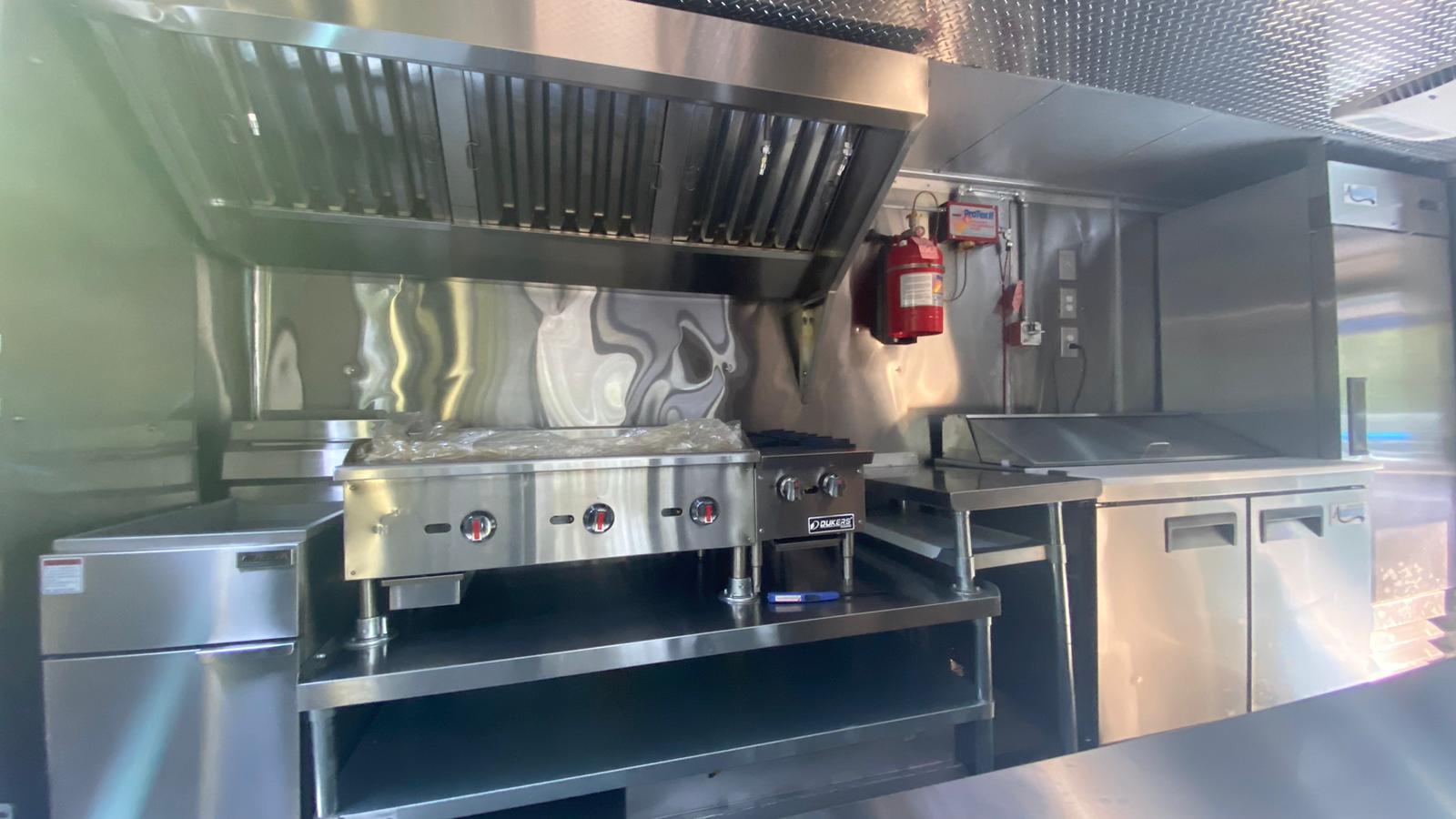
Nobody talks about this, but your truck's build quality is a profit margin issue. A poorly insulated kitchen wastes propane. An undersized water tank means more trips to the commissary. A bad electrical system burns through generator fuel.
Your food truck water tank installation affects how many hours you can operate before refilling. Every hour you spend driving to refill is an hour you're not selling. That's not overhead — that's lost revenue.
Same logic applies to your equipment package. Buying cheap fryers that break every three months costs more in repair fees and downtime than buying commercial-grade once. Check what a real food truck kitchen equipment package price looks like before you make that mistake.
And once your truck is running, don't ignore the outside. A faded wrap makes people assume the food is stale too. Simple food truck wrap maintenance keeps your truck looking like the food tastes — and that keeps lines moving.
Before You Open: Know Your Break-Even Number
If you're still planning your truck, do this math before spending a dollar. Your break-even point is your monthly fixed costs divided by your average profit per item.
Say your fixed costs are $4,000 monthly. Your average profit per item is $3.50. You need to sell 1,143 items per month — about 38 per day if you operate 30 days. That's your floor. Below that, you're losing money.
If that number feels impossible, you have three options: cut fixed costs, raise prices, or find a cheaper build. That last one is where mobile kitchen consultations can save you from a $20,000 mistake. Get real numbers before you commit, not after.
And if you're already running, run this audit this weekend. Not next month. This weekend.
The owners who survive in this business aren't the best cooks. They're the ones who know their numbers cold. The ones who can tell you their margin on every single item without checking a spreadsheet. That's the difference between a food truck that lasts five years and one that's for sale on Facebook Marketplace by August.
You don't need to love accounting. You just need to respect it enough to check your math weekly. Because the market doesn't care how good your brisket is if the numbers don't work.
Te puede interesar: Houston Food Truck License Requirements
Te puede interesar: Food Truck Design For Cold Weather
Te puede interesar: Food Truck Safety Checklist