Food Truck Conversion Guide: Step-by-Step Process
Most Food Truck Conversion Guides Are Written by People Who've Never Built One
Here's a number worth sitting with: a full commercial food truck conversion in 2026 runs $65,000 to $150,000 depending on chassis, equipment, and how honest your builder is with you. That's not a typo. And yet half the "food truck conversion guide" articles floating around still quote $30,000 like it's 2018. The math hasn't worked that way for years.
So let's do this properly. This is the step-by-step process the way it actually happens in a shop — not the sanitized version. If you're planning a conversion this year, the sequence below is the difference between a truck that passes inspection on the first try and one that sits in a lot for six months bleeding money.
What nobody mentions up front: the conversion itself is rarely the problem. The problem is doing the steps out of order. Gas before electrical. Equipment before ventilation. Permits before you've locked the layout. Every one of those mistakes costs real money to undo.
Step 1: Pick the Chassis Before You Dream About the Menu
Everyone wants to start with the food. Don't. Start with the box the food lives in.
A used step van or box truck in decent condition runs $18,000 to $45,000 in 2026, and that spread matters more than people realize. A 16-foot box truck gives you a workable line; a 12-foot van forces compromises on prep space you'll feel every single service. The chassis dictates your kitchen layout, your equipment footprint, and your weight distribution — which, by the way, is a legal issue, not just a comfort one.
Buy the chassis with the build in mind. If you're weighing a full truck against a trailer, it's worth reading the breakdown on food truck vs concession trailer pros and cons before you commit — the two paths have very different conversion costs and permit realities.
What to check on any used chassis
Frame rust (especially in snow-belt states), GVWR rating, and whether the electrical system can handle a commercial load. A $22,000 truck with a soft frame is a $40,000 truck. Get it inspected by someone who builds kitchens, not just a mechanic.
Step 2: Lock the Layout Before Anyone Cuts Metal
This is where the real food truck conversion guide diverges from the fantasy. You need a layout drawing — to scale — before fabrication starts. Cooking line, prep, refrigeration, hand sink, three-compartment sink, ventilation, generator placement, propane tank location. All of it.
Why so rigid? Because health departments inspect against your submitted plan. Change the layout mid-build and you may need to resubmit. In cities like Austin and Los Angeles, that resubmission can add three to six weeks and a few hundred dollars in fees. The layout is the cheapest thing to get right and the most expensive thing to get wrong.
If you haven't nailed down your equipment list yet, start with the essential 2026 kitchen equipment list — it maps equipment to layout constraints so you're not designing around a fryer that physically won't fit.
Step 3: The Build Sequence That Actually Works
Here's the order experienced fabricators follow, and it's not arbitrary:
1. Strip and frame. Gut the interior, reinforce the floor, address rust. $3,000–$8,000.
2. Insulation and walls. Commercial-grade insulation, then stainless or FRP wall panels. $4,000–$9,000.
3. Electrical rough-in. Wiring, breaker panel, generator mount, shore power hookup. Do this before walls close. $5,000–$12,000.
4. Plumbing. Fresh water tank, grey water tank, sinks, water heater. $3,500–$8,000.
5. Gas and ventilation. Propane lines, hood system, fire suppression. This is the step that fails inspection most often. $6,000–$15,000.
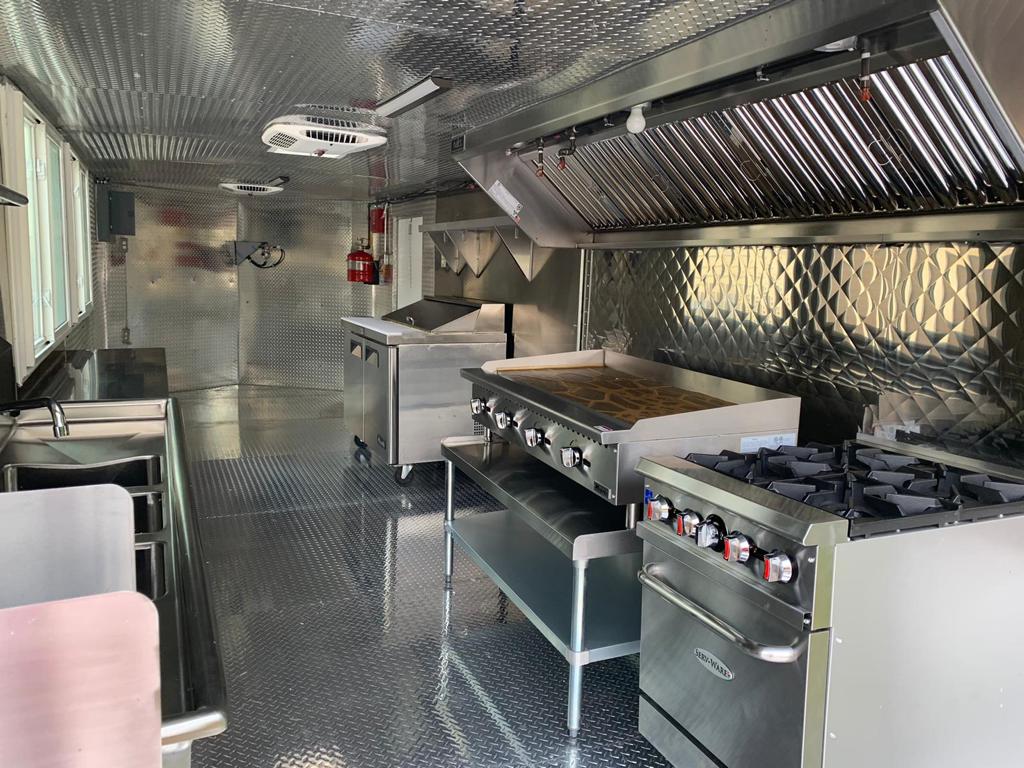
6. Equipment install. Now — and only now — the cooking line goes in. $15,000–$45,000 depending on menu.
7. Finishing. Counters, storage, POS, lighting, wrap. $4,000–$10,000.
Notice the gas and ventilation come before equipment. That ordering is not optional. A hood system installed after the range means tearing out cabinetry. I've watched operators eat $4,000 in rework because they wanted to "see the kitchen come together" first.
Where the Food Truck Conversion Budget Actually Blows Up
The build itself is predictable if you plan it. The overruns come from three places, and they're almost always the same three.
Fire suppression and hood systems. A commercial hood with fire suppression runs $6,000 to $14,000 installed. Many first-timers budget $3,000. That gap alone can sink a tight plan.
Weight and GVWR. Load a truck past its gross vehicle weight rating and you're looking at suspension upgrades, brake work, and possibly a different chassis. Add $5,000 to $12,000 if you get this wrong.
Permit and inspection delays. Every week a truck sits unfinished in a shop is a week of rent, insurance, and lost revenue. In high-demand markets like Nashville and Denver, inspection queues can run four to eight weeks in peak season. Budget time, not just dollars.
The operators who stay on budget aren't luckier. They front-loaded the planning and got a professional to sanity-check the numbers before fabrication. That's what mobile kitchen consultations are for — catching the $14,000 hood before it becomes a surprise.
The Permits and Inspections Nobody Warns You About
Your conversion isn't "done" when the last screw goes in. It's done when the health department signs off — and that's a separate project.
You'll need a food service permit, a fire marshal inspection (for the hood and suppression system), a commissary agreement in most jurisdictions, and in many cities a mobile food vendor license on top of all of it. Fees vary wildly: roughly $300 to $1,200 depending on the city, plus annual renewal. In New York, the mobile food vendor license alone is a capped, waitlisted process that can take over a year. Plan around it.
This is also where your business plan and your build intersect. Lenders and health departments both want to see the same thing: a coherent operation. If you're applying for financing, the process in what to expect from a food truck business plan consultation will save you from submitting a plan that gets bounced.
Should You Build or Buy Turnkey?
It depends — and that's not a dodge. A custom build gives you exactly the kitchen your menu needs. A turnkey truck gets you operating in weeks instead of months, often for less total cash because the builder already absorbed the design and permitting learning curve.
The honest split: if your menu is standard (tacos, burgers, coffee, BBQ), a turnkey truck is usually the smarter financial move. If your concept is genuinely unusual — a specific cuisine, a tight workflow, equipment nobody stocks — custom conversion earns its premium. The turnkey food truck benefits and checklist lays out which side of that line you're on.
One more thing people forget until week one of operation: the wrap. A full commercial wrap runs $3,500 to $7,000 in 2026, and it's not cosmetic — it's your only marketing in a market where 73% of new trucks don't survive to year two. See the real numbers in how much a food truck wrap costs in 2026 before you finalize the budget.
The Step Most Guides Skip: Get the Numbers Checked Before You Cut
You can read a hundred food truck conversion guides and still get the sequence wrong for your specific concept, city, and budget. The build is engineering. The planning is where you either protect your money or lose it.
If you want a real number for your chassis, your menu, and your city — not a blog estimate — get a custom quote before fabrication begins. The cheapest conversation you'll have in this whole process is the one that happens before anyone touches a welder.
Because here's the thing: the truck doesn't fail because the food is bad. It fails because the build went sideways and the operator ran out of runway before the first service. Get the sequence right, and the cooking takes care of itself.