Custom Food Truck Cost Breakdown: 2026 Prices
Most Custom Food Truck Quotes Are Missing a Third of the Price
Ask five builders for a custom food truck cost breakdown and you'll get five numbers that don't match — and none of them will be the number you actually pay. That's not because builders are dishonest. It's because the industry quotes in fragments. One gives you the shell. Another gives you the shell plus equipment. Almost nobody gives you the full picture until you've already signed.
Here's what a real 2026 build looks like, line by line, so you can walk into a conversation knowing where the money actually goes.
The Chassis Is the Cheapest Line Item — and That's the Trap
A new step van chassis in 2026 runs $45,000 to $65,000 depending on make and size. A used one in decent condition: $18,000 to $30,000. Sounds manageable, right? That's the number every first-time buyer fixates on.
What nobody mentions is that the chassis is roughly 20% of your total. The other 80% is everything you bolt onto it.
Fabrication and build-out: $55,000 to $110,000
This is where custom food truck cost breakdowns get real. Fabrication covers the box build, insulation, walls, flooring, electrical rough-in, plumbing rough-in, ventilation, and the exterior wrap. A basic build-out on a used chassis might land at $55,000. A full custom build with a 16-foot box, custom stainless workstations, and a wrapped exterior will push past $110,000. The spread depends on square footage, materials, and how much of the layout is truly custom versus adapted from a proven template.
Where the Kitchen Equipment Budget Actually Goes
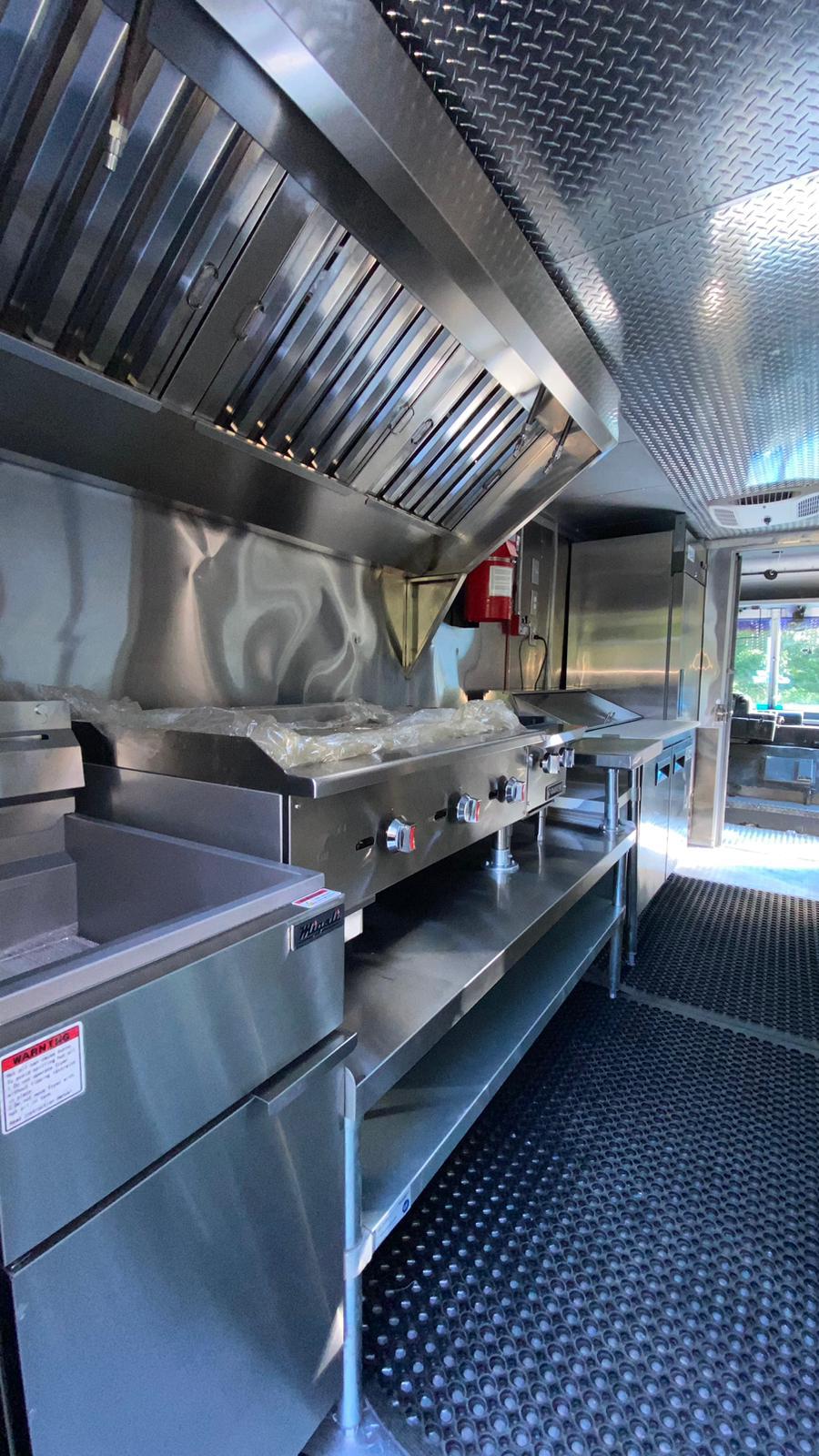
Equipment is the second-biggest line, and it's the one buyers underestimate most often. A commercial kitchen package for a food truck in 2026 runs $25,000 to $50,000. That covers the hood system, fryer, flat top, refrigeration, prep tables, sinks, and fire suppression.
But here's what gets left off the quote: installation labor. Mounting a hood, running gas lines, and certifying a fire suppression system adds $6,000 to $12,000 on top of the equipment itself. If you're building a menu around a wood-fired oven or a specialized cooking line, add another $10,000 to $20,000.
This is exactly the kind of gap that an equipment installation checklist is designed to catch before you sign.
Permits, Commissary, and the Costs That Follow You
One-time permit and inspection fees in most U.S. cities run $1,500 to $4,000. Not catastrophic. But the recurring costs are where new owners get blindsided.
Commissary rent — the licensed kitchen you're legally required to park at for cleaning and storage — runs $400 to $1,200 a month depending on the city. In Seattle, where rules are stricter than most people assume, commissary and inspection requirements can add meaningful overhead before you've sold a single taco. If you're building in the Pacific Northwest, it's worth reading up on Washington's commissary rules before you commit to a location.
Add insurance ($1,500 to $3,500 a year), a generator or shore power setup ($3,000 to $8,000), and the POS and signage package ($2,000 to $5,000), and you're looking at a realistic total of $130,000 to $220,000 for a fully custom build in 2026.
Why Your Quote Doesn't Match the One Down the Street
Two builders, same city, same menu concept — and a $40,000 difference in the final number. That gap almost always comes down to three things: the condition of the chassis, whether fabrication is built to spec or adapted from a template, and how much of the equipment package is installed versus delivered on a pallet.
The truth is that a custom food truck cost breakdown is only useful if it's specific to your concept. A coffee truck and a smash burger truck share a chassis and not much else.
If you want a build that actually matches the quote, the place to start isn't the chassis — it's the builder. These seven factors separate the shops that deliver on budget from the ones that don't.
What the Build Process Actually Looks Like, Month by Month
Most custom builds take 12 to 20 weeks from signed contract to keys. The first four weeks are design and permitting. Weeks five through fourteen are fabrication. The final two to four weeks are equipment install, inspection, and wrap.
If you want the full sequence — including what to expect at each inspection — this step-by-step guide walks through it without the fluff. And if you're still sketching the budget on the back of a napkin, the real numbers behind build budget planning will save you from a very expensive surprise in month three.
The Number That Matters Isn't the Total — It's the Contingency
Every experienced builder will tell you the same thing: whatever your custom food truck cost breakdown says, add 15%. Not because the builder is padding the quote, but because something always changes — a chassis needs a new transmission, a health inspector wants a different sink configuration, a wrap design takes three revisions instead of one.
The buyers who stay on budget aren't the ones who found the cheapest quote. They're the ones who planned for the quote to be wrong.
If you want to talk through what a real number looks like for your specific concept, mobile kitchen consultations are the fastest way to get there. And if you're ready to put a real figure against your menu, get a custom quote — the number will be specific to your build, not a ballpark.