How to Design a Food Truck Kitchen for High Volume
Most Food Truck Kitchen Designs Are Backwards
You’re not just trying to figure out how to design a food truck kitchen for high volume; you’re trying to solve a problem you can’t yet see. The real problem isn't fitting equipment in a 20-foot box. It’s the invisible, soul-crushing friction that happens when you have 40 tickets hanging and your cook has to take three steps, pivot, and reach over a sink just to grab a ladle. That friction costs you $300 in lost sales on a Saturday night and burns out your best employee by October. Everyone knows you need a grill, a fryer, and a fridge. What they don’t tell you is that the secret to volume isn't bigger equipment—it's a smarter path.
The "Workflow First" Mindset
Forget starting with a floor plan. Start with your most popular item. Let’s say it’s a Nashville hot chicken sandwich. Now, trace the journey of that sandwich from the moment the order is placed until it’s handed out the window. Raw chicken comes from cold storage, gets battered and dredged, goes into the fryer, is sauced, placed on a bun (toasted, of course), topped, wrapped, and bagged. Every single movement in that sequence is a step, a reach, or a turn for your cook. Your entire kitchen design is just the physical support system for that one, perfect sequence. If that path isn't a straight, logical line, you’re building in exhaustion.
This is why generic layouts fail. A taco truck’s flow is radically different from a gourmet burger truck’s. Designing before you’ve mapped your menu’s workflow is like building a highway without knowing where the cities are.
Where the Rubber Meets the Road: The Hot Zone
The heart of your high-volume operation is the 4-foot stretch where one cook can touch the fryer baskets, the plating station, and the pass-through window without moving their feet. This is the hot zone. In a well-designed truck, this zone is sacred, unobstructed, and has dedicated landing space for hot food coming out of fryers and off griddles. I’ve seen trucks in Houston add a simple 18-inch stainless steel shelf next to the fryer as an afterthought and increase their output by 15% because the cook finally had a place to put the basket down. It’s that simple, and that often overlooked.
Critical Equipment Placement for Speed
This is where theory gets real. Let’s talk about your three most critical pieces for volume and where they absolutely must go.
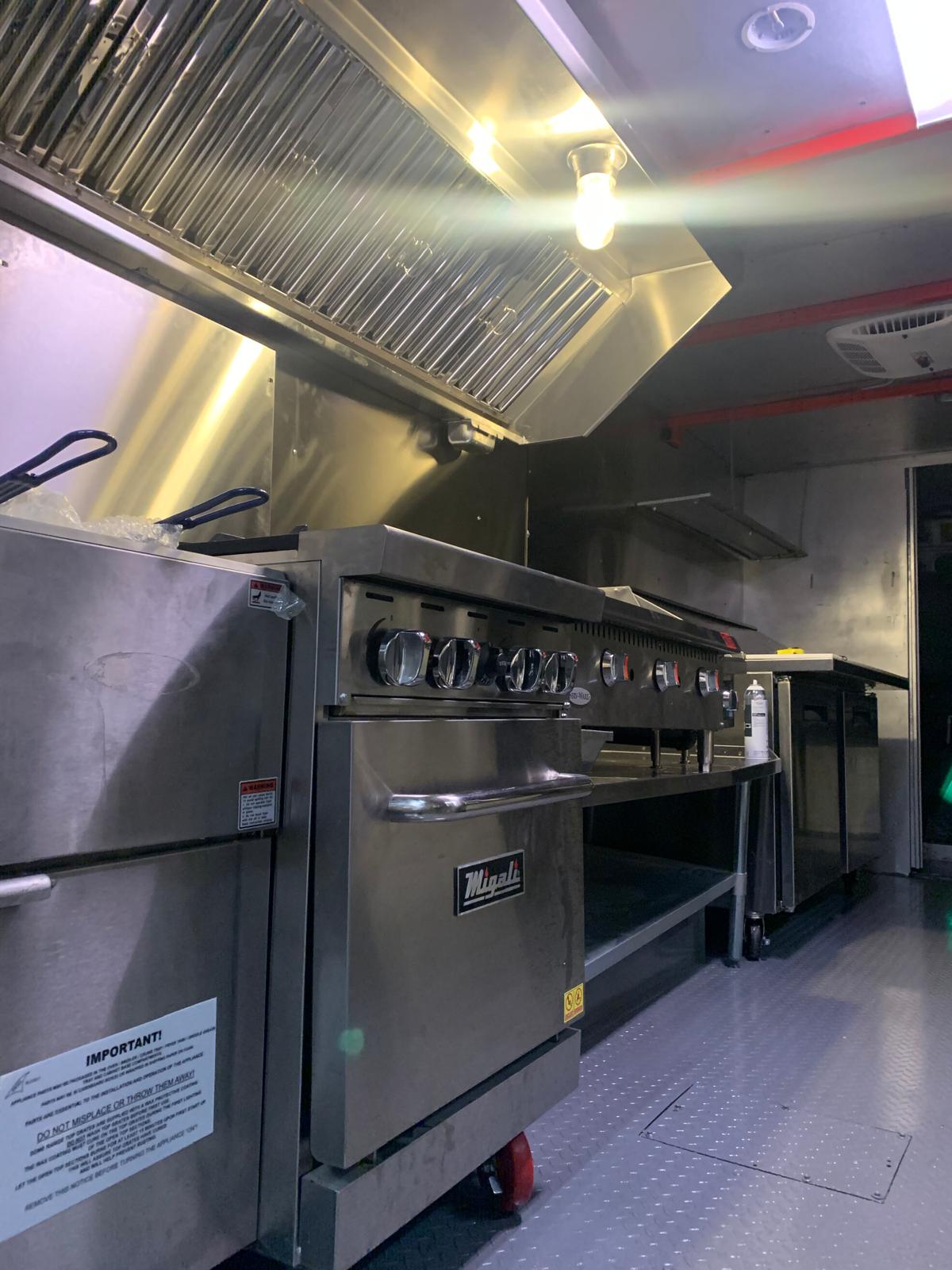
The Fryer: It’s not just a fryer; it’s your bottleneck or your engine. For high volume, you need a high-recovery, dual-basket fryer. But its placement is everything. It must be directly adjacent to your primary cold storage (the lowboy fridge underneath is ideal) so raw product moves two feet from cold to fryer. Its exhaust hood must be directly above it—no creative ductwork bends that reduce efficiency. And it must open toward the hot zone, not a wall. A fryer door that swings open into a walkway is a shin-seeking missile during rush hour.
The Flat Top Griddle: This is your real estate. Every square inch is money. For a burger-heavy concept, you need at least a 36-inch griddle. Its placement should be in a direct sightline to the order printer or screen. The cook should see the ticket and immediately know what quadrant of the griddle to hit. The seasoning station (salt, pepper, onions) must be mounted on the wall within arm’s reach of the griddle’s center. If your cook has to turn around, you’ve lost 10 seconds per ticket.
The Cold Line: This isn’t one piece, but a system. Your high-volume toppings (lettuce, tomato, cheese, sauces) live in inserts in a refrigerated prep table, directly across from the hot zone. The cook pivots from the griddle, builds the burger on the cold line’s cutting board, and pivots back to the pass. The distance between the hot protein and the cold toppings should be less than an arm’s length. Any further, and you’ve created a traffic jam.
The Hidden Cost of Poor Design
Poor workflow doesn’t just slow you down; it costs you real money. Let’s do some 2026 math. If a chaotic layout adds just 30 seconds to each order’s assembly time, and you do 150 orders on a Friday night, you’ve just wasted 75 minutes of prime service time. At an average ticket of $18, that’s over $300 in potential sales you literally could not serve because your cook was playing kitchen Twister. Over a year, that’s a five-figure loss. This is why a custom design from a company that understands throughput, like getting a custom quote for a purpose-built rig, isn’t a luxury—it’s an ROI calculation.
And it impacts more than sales. Employee turnover is the silent killer of food truck margins. A frustrating, inefficient kitchen is the number one reason good cooks leave. They’d rather make a dollar less an hour at a restaurant where they aren’t constantly battling their own workspace.
What Your Builder Probably Won't Tell You
Most builders focus on the shell, the wrap, and the shiny appliances. They’ll give you a standard three-bay sink setup because it’s code, but they won’t ask if you’d be better served with a two-bay sink and a larger dedicated hand-wash station to keep health inspectors happy and line movement fluid. They’ll install standard 24-inch deep counters, not realizing that 30-inch deep counters on one side create crucial landing space for sheet pans and prep containers during a rush.
Ventilation is another blind spot. For a high-volume truck with a fryer and a griddle going full blast in a Texas summer, you need a ventilation system rated for at least 20% more BTU than your equipment puts out. A weak hood means a 120-degree kitchen, a miserable cook, and condensation dripping into the food. It’s a spec you must demand. For a deep dive on real-world costs in a major market, see what the average cost to build a food truck in Houston actually looks like when you factor in these performance essentials.
Your First Step Isn't a Sketch
Before you talk to a fabricator, do this: get a roll of painter’s tape and map your kitchen on your garage floor. Use boxes for equipment. Then, with your menu in hand, walk through making ten of your most complex item. Time it. Feel the pivots. Notice the dead-end steps. This two-hour exercise will teach you more about how to design a food truck kitchen for high volume than any catalog.
Then, bring that knowledge to a professional who speaks workflow. The goal isn’t to cram in every appliance you saw on a restaurant supply website. The goal is to create a machine where people and food move in a continuous, logical, fast loop. That’s what gets you through a festival line of 300 people without a mutiny. If you're ready to move from theory to a specific plan, professional mobile kitchen consultations are built for this exact moment—translating your menu’s potential into a physical layout that works as hard as you do.
Because in the end, a great food truck kitchen isn't seen. It's felt. In the calm focus of your crew during the rush, and in the consistent speed of your service, day after day.