SEO Article · July 12, 2026
Commercial Kitchen Equipment for Food Trucks: Installation Guide
How Much Does It Really Cost to Install a Commercial Kitchen in a Food Truck?
Nobody gives you the real number upfront. You'll see "$30k for a fully equipped food truck" on Facebook Marketplace, click the listing, and find a rusted-out cargo van with a camp stove bolted to plywood. That's not a commercial kitchen. That's a fire waiting to happen. The truth is, installing commercial kitchen equipment for food trucks costs between $18,000 and $65,000 depending on your concept, local health department requirements, and whether you're building from scratch or retrofitting an existing vehicle. And if you're in Houston, where I've watched 73% of new food trucks close before their second year, the equipment installation is usually where the budget dies first. Let me walk you through what actually matters — not the brochure version, but the version that keeps you open past year two.What "Commercial" Actually Means for a Food Truck
Here's what few people tell you: the equipment itself is only half the battle. The installation is what makes it commercial or not. A $4,000 True refrigerated prep table bolted to an unsecured surface with a loose gas line is not commercial. It's a liability. For a food truck to pass health inspection in most U.S. cities — and I'm looking at you, Virginia, Texas, and Washington State — every piece of equipment must be:- NSF-certified (National Sanitation Foundation)
- Properly secured for transit (bolted to the floor or frame)
- Connected to approved gas, electrical, or water systems
- Accessible for cleaning (no sealed-in-place equipment)
- Vented according to local fire codes
The Equipment That Actually Matters (and What You Can Skip)
I've seen first-time owners spend $8,000 on a combi oven they use twice a week while cooking on a $200 electric griddle that fails inspection. The hierarchy of equipment importance for a food truck is not what you think.Non-Negotiable (Must Be Commercial Grade)
- Fire suppression system — $1,500 to $3,500 installed. This is not optional. If you have any cooking equipment that produces grease-laden vapors, you need an Ansul system or equivalent. Period.
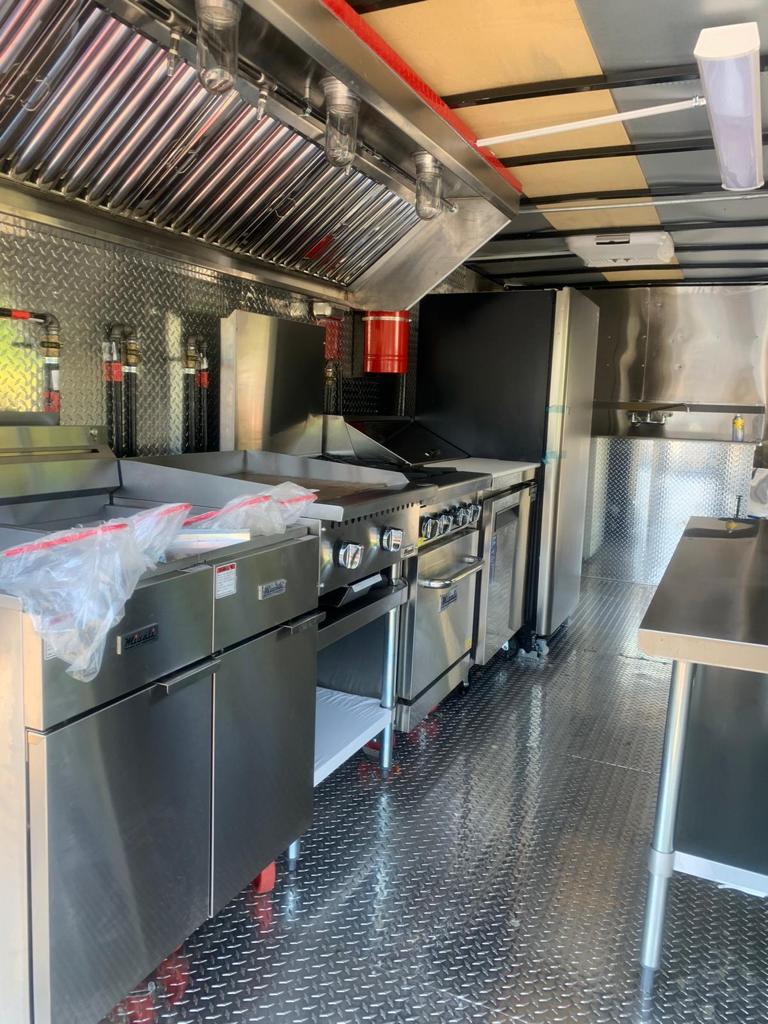
- Commercial exhaust hood — $2,000 to $6,000 depending on size and whether you need a Type I (grease) or Type II (steam/heat) hood. This is where how to install a commercial exhaust hood in a food truck becomes the most important article you'll read.
- NSF refrigeration — $1,200 to $4,000 per unit. No residential fridges. They won't hold temp, they'll vibrate apart, and the health department will fail you.
- Three-compartment sink — $800 to $2,500 with drain boards. Must be plumbed to a gray water tank.
- Handwash sink — $400 to $1,000. Must be separate from the food prep sink and must have hot water.
Concept-Dependent (Spend Here Only If You Need It)
- Griddle/flat top — $800 to $2,500
- Deep fryer — $1,000 to $4,000 (requires more hood CFM)
- Convection oven — $2,500 to $8,000
- Warming drawers — $600 to $2,000
Why Your Houston Conversion Budget Is Wrong
Let me give you a concrete example. A client in Houston came to us with a $45,000 budget for a fully built-out taco truck. He'd spent $12,000 on the used truck itself. That left $33,000 for equipment, installation, permits, and wrap. Here's where the budget actually went:- NSF refrigerator (2 units): $3,200
- NSF freezer: $1,800
- Flat top griddle: $1,500
- Three-compartment sink + hand sink: $2,100
- Commercial exhaust hood + installation: $4,800
- Fire suppression system: $2,800
- Propane system + gas lines: $1,200
- Electrical system (inverter, batteries, wiring): $3,500
- Plumbing (water tanks, pumps, drains): $2,400
- Permits and inspection fees: $1,600
- Wrap and branding: $3,000
- Miscellaneous (shelving, smallwares, signage): $2,000
The Installation Sequence Nobody Talks About
Most people install equipment in the wrong order. They buy the fridge, bolt it down, then realize the gas line needs to run behind it. Now the fridge has to come out. This happens constantly. The correct sequence for installing commercial kitchen equipment for food trucks:- Structural prep — Floor reinforcement, wall framing, ceiling bracing for the hood
- Electrical rough-in — Run all wiring before anything is mounted
- Plumbing rough-in — Water lines, drain lines, tank placement
- Gas lines — Propane or natural gas, with shut-off valves at each appliance
- Exhaust hood and fire suppression — These go in before the cooking equipment
- Heavy equipment first — Refrigeration, cooking equipment, sinks
- Light equipment and shelving — Warming drawers, prep tables, storage
- Final connections — Gas, electrical, and water hookups to each unit
- Testing and inspection prep — Run everything, check temps, verify fire suppression